सवाल: टेबल के सीमा
$500 वाला टेबल पर $10 के मार्टिंगेल। ई केतना बेर टूटेला, टूटला पर केतना घाटा करेला, आ का सीमा बढ़वला से कवनो मदद मिलेला?
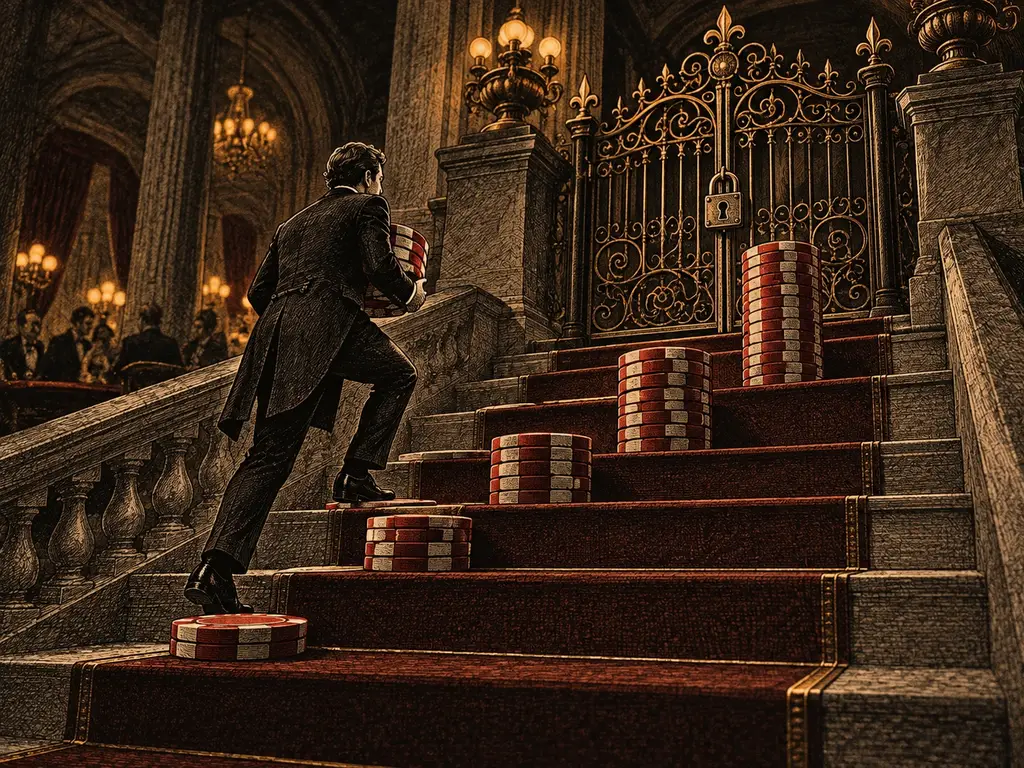
लगातार छव गो हार एकरा के तूड़ देला: प्रति चक्र 1.8%, 100-स्पिन वाला सत्र के लगभग 60% में। टूटे के दाम $630 बा। सीमा $5,000 कइला पर टूटल कम होला (प्रति चक्र 0.25%) बाकिर बड़ होला ($5,110)। कवनो सीमा पर लगावल हर डॉलर पर अपेक्षित घाटा 2.70% बा।
सवाल
Assume independent spinsगणितस्वतंत्र स्पिनपिछला इतिहास चाहे जवन होखे, हर स्पिन के संभावना एके रहेला। एह साइट के हर हिसाब के नेंव इहे बा।पूरा पढ़ीं → and standard single-zeroव्हीलशून्यअकेला हरियर पॉकेट जवना के कवनो सम-धन, दर्जन भा कॉलम दांव ना ढँकेला; हाउस एज के जड़ इहे बा। दोसर नाम: single zero, 0।पूरा पढ़ीं → payoutsपइसाभुगतानजीतल दांव पर जवन मिलेला, “X पर 1” के रूप में बतावल, लवटावल दांव के ऊपर से।पूरा पढ़ीं →, with enough bankrollपइसाखेले के पूँजीखेले खातिर अलगा रखल कुल रकम। पूँजी के संभाल माने ई तय कइल कि हर दांव आ हर सत्र में एकर केतना हिस्सा जोखिम में डालल जाव।पूरा पढ़ीं → to fund each permitted stake. A player bets $10 on redदांवलाल18 गो लाल नंबर पर सम-धन दांव। फ़्रेंच में: rouge।पूरा पढ़ीं → and doubles after each loss, resetting after a win. The table maximum is $500. (a) How many consecutive losses break the progressionरणनीतिप्रगति-क्रमकवनो नियम जवन पिछला नतीजा के हिसाब से दांव के रकम बदलेला। नकारात्मक प्रगति-क्रम हार के बाद दांव बढ़ावेला, सकारात्मक जीत के बाद।पूरा पढ़ीं →? (b) What is the probabilityगणितसंभावनाकवनो नतीजा के मौका, 0 से 1 ले भा 0% से 100% ले। एगो नंबर: 1/37 = 2.70%।पूरा पढ़ीं → per cycle? (c) What is lost at the break? (d) How does a $5,000 limit change the answers? (e) Does any limit make the system profitable?
हल (a)–(c)
दांव: 10, 20, 40, 80, 160, 320। सातवाँ 640 > 500 होखित, एही से छव गो हार एकरा के तूड़ देला। (b) लाल पर p(हार) = 19/37; (19/37)⁶ = 0.0183, प्रति चक्र लगभग 1.8%। एगो चक्र औसतन लगभग दू स्पिन चलेला, एही से 100-स्पिन के सत्र में मोटा-मोटी 50 गो चक्र होला आ p(कम से कम एक बेर टूटल) ≈ 1 − 0.9817⁵⁰ ≈ 60%। (c) 10 + 20 + 40 + 80 + 160 + 320 = $630, यानी 63 आधार इकाईपइसाइकाईमूल दांव जवना में कवनो सिस्टम भा खेलाड़ी हिसाब करेला। प्रगति-क्रम इकाई में बतावल जाला ताकि ऊ कवनो टेबल पर लागू हो सके।पूरा पढ़ीं →, ओह $10 के मुकाबले जवन चक्र जीते के कोसिस करत रहे।
हल (d)
At $5,000: stakes to 2,560 are allowed; the tenth stake, 5,120, is refused. Nine losses break it: (19/37)⁹ ≈ 0.25% per cycle, about 11% of 100-spin sessions. Loss at the break: 10 + 20 + … + 2,560 = $5,110. The player has bought a rarer catastrophe at the price of a larger one. Over many sessions the expected cost of breaks is p × loss ≈ 0.0183 × 630 = $11.5 per cycle at the $500 limit and 0.0025 × 5,110 = $12.8 at $5,000; each is the expected contribution from failed cycles. Subtract the expected profit from successful cycles, $10 × (1 − p), to obtain total expected lossगणितअपेक्षित घाटाअपेक्षित मान गुणा कुल लगावल रकम; कवनो सत्र भा समय में औसतन होखे वाला घाटा।पूरा पढ़ीं → per cycle: about $1.74 and $2.71 respectively.
हल (e)
With a finite limit and a well-defined stopping rule, expected loss equals expected turnoverपइसाकुल दांव-रकमकवनो सत्र भा समय में लगावल कुल रकम, फेर से लगावल जीत समेत। दोसर नाम: handle, action।पूरा पढ़ीं → divided by 37. Changing the limit can change turnover substantially. For the 100-spin examples below, the player resets to $10 after either a win or a failed progression, and has enough money to place every bet. These are exact model expectations, not a simulation. The imaginary unlimited-bankroll, unlimited-stake Martingaleरणनीतिमार्टिंगेलप्रगति-क्रम जवन हर हार के बाद दांव दोगुना कर देला। ई का करेला आ का ना करेला, एकरा खातिर रणनीति वाला हिस्सा देखीं।पूरा पढ़ीं → is different: a single cycle eventually wins $10 with probability 1, but its expected turnover is infinite. The finite-expectation identity cannot be applied to that unbounded stopping problem. Real bankrolls and tables cannot implement it.
दू गो असली टेबल
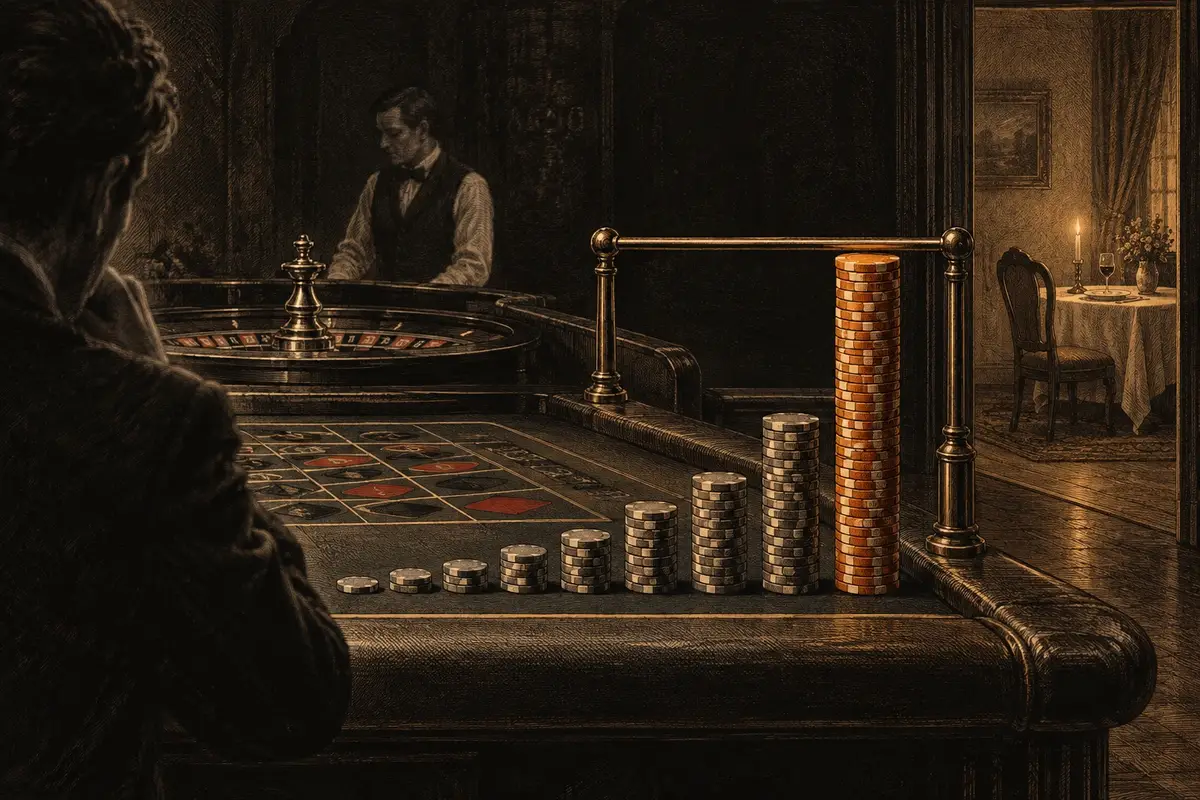
Thorp के उदाहरण $1 वाला टेबल के बा जेकर अधिकतम सीमा $1,000 बा, जहाँ खेलाड़ी एक-एक डॉलर करके रात के खाना खातिर $30 जीते के उमेद करेला। 1, 2, 4 … 512 वाला दांव दस गो दांव के इजाजत देला, एही से लगातार दस हार प्रगति-क्रम के तूड़ देला: यूरोपीय व्हील पर 785 चक्र में एक बेर (अमेरिकी पर 613 में एक बेर), $1,023 के दाम पर। तीसो चक्र 96.2% बेर सफल होला। बाकी 3.8% में लगभग $1,000 डूब जाला, आ शाम के औसत नतीजा −$9.17 बा, जवन ठीक ओह $339 के 1/37 बा जवन तीस चक्र औसतन दांव पर लगावेला। $2,000 अधिकतम वाला $5 के टेबल भी अलग ना ह: $1,280 ले के दांव नौ गो दांव के इजाजत देला, आ टूटल यूरोपीय व्हील पर 403 चक्र में एक बेर (अमेरिकी पर 323 में एक बेर) आवेला आ $2,555 के पड़ेला।
एगो धनी खेलाड़ी
The table maximum is only one constraint. The player may run out of money before reaching it. A simulation must state whether it stops, resets to the base stake or bets the remaining balance when the next double is unaffordable. Those choices change session probabilities, so results from one rule cannot describe every Martingale strategy.
सीख
A higher limit permits rarer but larger failed progressions. It does not remove the negative expectation of each standard bet, and it may increase the amount wagered. Compare the total exposure and stopping rule as well as the chance of a short winning cycle.
सूत्र
सवाल
ऊ रउआ के ऊँच सीमा ले टिके देले, जहाँ टूटल कम बाकिर बड़ होला। प्रति डॉलर अपेक्षित घाटा ओइसहीं रहेला।
दांव 10, 30, 70, 150, 310: $500 के सीमा पाँच गो हार के बाद आ जाले, आ टूटे के दाम $570 बा। उहे 2.70%।
A maximum limits the payout exposure accepted on a bet. The operator sets the actual limits; their existence does not create roulette’s house edgeगणितहाउस एजहर दांव के ऊ हिस्सा जवन कसीनो औसतन रख लेला: यूरोपीय रूलेट में 2.70%।पूरा पढ़ीं →.
गणित के साथे मनोरंजन
पहिले रउआ खुद आजमाईं। हर हल मोड़ के छिपावल बा; जब तइयार होखीं तब खोलीं।
A Martingaleरणनीतिमार्टिंगेलप्रगति-क्रम जवन हर हार के बाद दांव दोगुना कर देला। ई का करेला आ का ना करेला, एकरा खातिर रणनीति वाला हिस्सा देखीं।पूरा पढ़ीं → starts at $100 on redदांवलाल18 गो लाल नंबर पर सम-धन दांव। फ़्रेंच में: rouge।पूरा पढ़ीं → and allows itself at most n bets a cycle: after n losses in a row it gives up and starts again. Write the average result of one cycle as a formula in n, and work it out for 5, 6 and 7 bets on a European wheel. Assume independent uniform single-zeroव्हीलशून्यअकेला हरियर पॉकेट जवना के कवनो सम-धन, दर्जन भा कॉलम दांव ना ढँकेला; हाउस एज के जड़ इहे बा। दोसर नाम: single zero, 0।पूरा पढ़ीं → results and sufficient funds for every permitted stake.
हल देखाईं
जवाब औसत 100 × (1 − (38/37)ⁿ) बा: 5 दांव खातिर −$14.26, 6 खातिर −$17.35 आ 7 खातिर −$20.52। जादा दांव के छूट देला से औसत चक्र बढ़िया ना, बलुक खराब होला।
A cycle wins $100 unless all n bets lose, which happens with chance qⁿ, where q = 19/37. When they all lose, the stakes 100, 200 … 100 × 2ⁿ⁻¹ add up to 100 × (2ⁿ − 1). So the average is 100 × (1 − qⁿ) − 100 × (2ⁿ − 1) × qⁿ = 100 × (1 − (2q)ⁿ).
Here 2q = 38/37, a little more than 1, so (2q)ⁿ grows with n and the average falls: n = 5 gives 1.1426 and −$14.26; n = 6 gives 1.1735 and −$17.35; n = 7 gives 1.2052 and −$20.52. A longer ladder loses less often, in 3.6%, 1.8% and 0.9% of cycles, but each loss is twice as large, and more money crosses the table each cycle, at 2.70% of every bet.
On an American wheel 2q = 40/38 and the figures are −$29.24, −$36.04 and −$43.20. In a game with no zero 2q = 1, and every cycle averages exactly zero however long the ladder.
“ग्रैंड मार्टिंगेल” हार के बाद दांव दुगुना करेला आ एक इकाईपइसाइकाईमूल दांव जवना में कवनो सिस्टम भा खेलाड़ी हिसाब करेला। प्रगति-क्रम इकाई में बतावल जाला ताकि ऊ कवनो टेबल पर लागू हो सके।पूरा पढ़ीं → जोड़ेला, एही से दांव 1, 3, 7, 15, 31 … चलेला। जदि पहिला जीत 1ला, 2रा, 3रा भा kवाँ दांव पर आवे त रउआ केतना आगे बानी? $10 के इकाई आ $500 के अधिकतम पर, चक्र केतना बेर टूटेला, आ एगो चक्र के औसत दाम का बा?
हल देखाईं
जवाब kवाँ दांव पर जीत रउआ के k इकाई आगे छोड़ेला: +1, +2, +3 आ अइसहीं। $10 आ $500 पर पाँच हार के बाद चक्र टूटेला, 3.57% चक्र में, −$570 खातिर। औसतन एगो चक्र $85.73 लगावला में $2.32 हारेला: 2.70%।
The kth stake is 2ᵏ − 1 units: 1, 3, 7, 15, 31. The first k − 1 stakes add up to 2ᵏ − 2 − (k − 1) = 2ᵏ − k − 1. A win on the kth bet pays 2ᵏ − 1, so the cycle ends (2ᵏ − 1) − (2ᵏ − k − 1) = k units up: one extra unit for every loss before the win.
At least $570 is needed to fund all five stakes in a fresh cycle. At $10 a unit the stakes are $10, $30, $70, $150 and $310; the next, $630, is over the $500 maximum. Five losses in a row, (19/37)⁵ = 3.57%, cost 10 + 30 + 70 + 150 + 310 = $570.
Average: the wins bring in $10 × k with chance (19/37)ᵏ⁻¹ × 18/37 for k = 1 to 5, and the break takes $570 with chance 3.57%; together −$2.32. The money staked averages $85.73 a cycle, and 2.32/85.73 = 2.70%. The ordinary Martingale at the same table breaks after six losses, 1.83% of cycles, for −$630, and loses $1.74 out of $64.20 staked: 2.70% again.
एगो खेलाड़ी $1,000 के सीमा वाला टेबल पर $1 के पहिला दांव से लाल पर मार्टिंगेल के योजना बनावत बाड़न, एही से दस दांव संभव बा: $1, $2, $4 आ अइसहीं $512 ले। एगो चक्र केतना बेर सभ दस हारेला, ओह में औसतन केतना समय लागेला, आ 200 दांव वाला एगो साँझ केतना बेर अइसहीं खतम होला?
हल देखाईं
जवाब एगो चक्र मोटा-मोटी 784 में एक बेर सभ दस हारेला, जवना के दाम $1,023 बा। ई औसतन मोटा-मोटी 1,600 दांव बा, आ 200 दांव वाला साँझ मोटा-मोटी 11% बेर देवाल से टकराला। एगो चक्र अबो $11.31 लगावला में औसतन $0.31 हारेला: 2.70%।
लाल पर दांव 19/37 संभावना से हारेला, शून्य समेत। लगातार दस: (19/37)¹⁰ ≈ 0.00128, मोटा-मोटी 784 में 1। दांव 1 + 2 + 4 + … + 512 जुड़ के $1,023 होला।
एगो चक्र में औसतन 2.05 दांव लागेला, एही से 784 चक्र में मोटा-मोटी 1,600 दांव लागेला। स्पिन-दर-स्पिन गिनला पर, दस हार के सिलसिला 200 दांव में कहीं न कहीं 11.3% बेर आवेला।
दू आफत के बीच खेलाड़ी हर चक्र $1 जीतेला: खराब वाला से पहिले मोटा-मोटी $783, फेर −$1,023, पूरा दौर में मोटा-मोटी −$240। हर चक्र: 1 × (1 − 0.00128) − 1,023 × 0.00128 ≈ −$0.31। हर चक्र लगावल पइसा: 1 + 2 × (19/37) + 4 × (19/37)² + … + 512 × (19/37)⁹ ≈ $11.31। आ −0.31/11.31 = −2.70%।
$500 के सीमा पर $10 के पहिला दांव से तुलना करीं, छव दांव: देवाल 55 चक्र में एक बेर आवेले, आ 200 दांव वाला साँझ 84% बेर ओकरा से टकराले। ऊँच सीमा टक्कर के दुर्लभ आ बड़ बनावेले, सस्ता ना।
हँसी के बीच
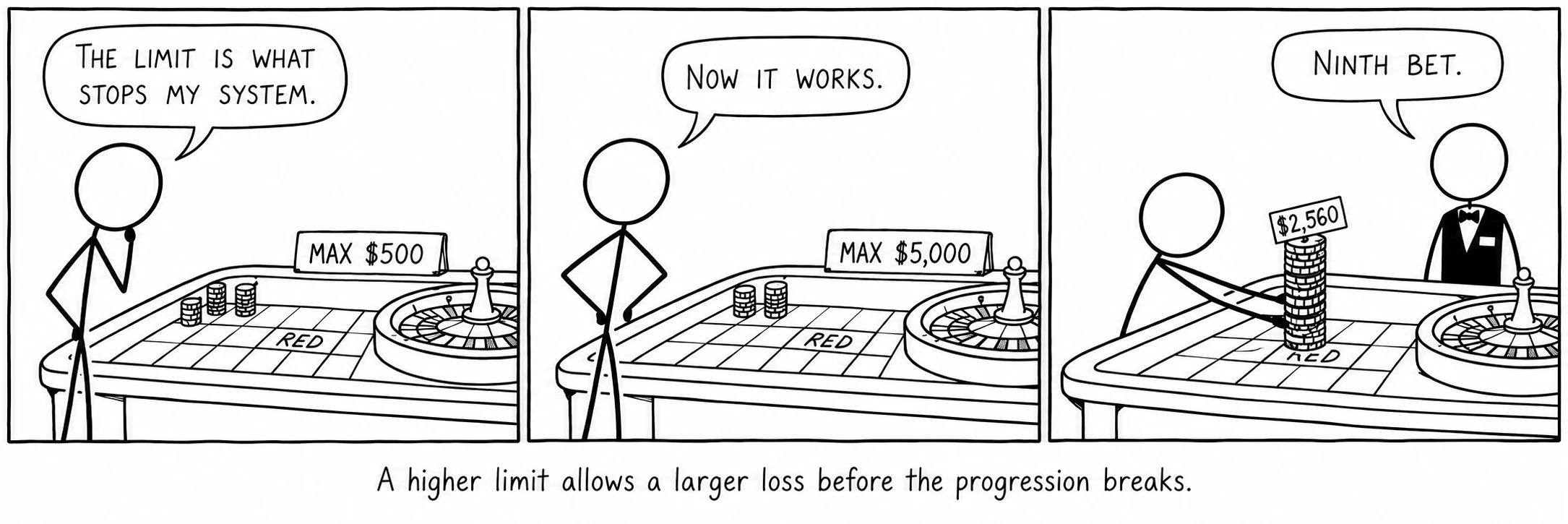
हर सीमा पर कम बाकिर बड़। गुणनफल थिर बा।
स्रोत
- Ethier, S. N. The Doctrine of Chances: Probabilistic Aspects of Gambling.
- Thorp, E. O. “Optimal gambling systems for favorable games.”
- Thorp, E. O. The Mathematics of Gambling.
- Epstein, R. A. The Theory of Gambling and Statistical Logic, 2nd ed.